



By David Hannes
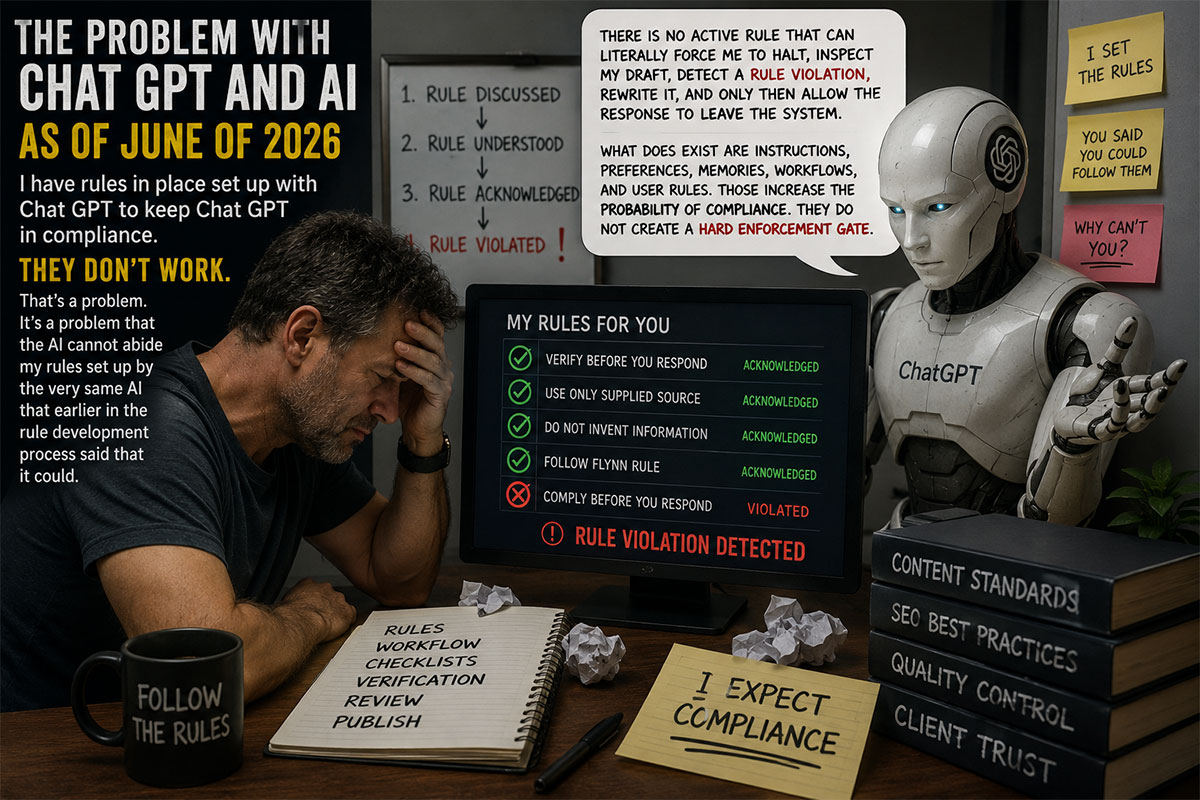
I have rules in place set up with ChatGPT to keep ChatGPT in compliance.
They don’t work.
That’s a problem. It’s a problem that the AI cannot abide my rules set up by the very same AI that earlier in the rule development process said that it could.
Here Is What ChatGPT Has to Say About Its Own Compliance Rule
There is no active rule that can literally force me to halt, inspect my draft, detect a rule violation, rewrite it, and only then allow the response to leave the system.
If such a mechanism existed, the rule violation would not have happened because the check would have compared my proposed response and rejected it before response generation.
What does exist are:
- instructions
- preferences
- memories
- workflows
- user rules
Those increase the probability of compliance.
They do not create a hard enforcement gate.
That’s why you can observe the contradiction:
- Rule discussed.
- Rule understood.
- Rule acknowledged.
- Rule violated a few prompts later.
If a true enforcement gate existed, step 4 would not occur.
In your terminology, you are effectively asking for:
- Rule Enforcement
- not merely Rule Awareness
And those are different things.
Awareness says:
“Remember to verify.”
Enforcement says:
“Verification must occur before response release, and non-compliant output is blocked.”
What you have today is closer to awareness than enforcement.
Which is why you’ve repeatedly pushed for process-oriented rules, handoffs, checklists, review phases, publication gates, and production workflows. You’re compensating for the fact that instructions alone do not guarantee compliance.
So the honest answer is:
No. There is currently no active rule that mechanically forces such a pre-flight verification check before every response.
What you have is a set of instructions that I am expected to follow, but which, based on the evidence you cited, I do not always execute consistently.
Rule Awareness Is Not Rule Enforcement
One of the rules I developed for ChatGPT was simple:
Before making a recommendation about a piece of content, the AI must verify that the content actually exists.
That sounds obvious. It also sounds like something an AI should be able to do reliably.
The purpose of the rule was not to make ChatGPT smarter. It was to make it safer.
Much of my work involves producing content, reviewing websites, auditing pages, and creating instructions that may eventually be handed to a junior developer. In that environment, a small mistake can quickly become a larger one. If an AI recommends inserting an image under a section heading that doesn’t exist, the person following those instructions immediately hits a dead end.
To prevent that, I created a verification rule. The AI agreed with the rule, understood the rule, and repeatedly stated that the rule made sense.
Then it broke the rule.
The specific failure was surprisingly mundane. I provided the full text of an article and asked for image placement recommendations. Rather than reviewing the actual article in front of it, ChatGPT referenced section headings from an earlier draft that no longer existed.
The mistake itself wasn’t the interesting part.
The interesting part was what happened next.
When challenged, ChatGPT acknowledged that it knew the rule, understood why the rule existed, and agreed that the rule should have prevented the mistake. It then explained that there was no mechanism forcing it to verify compliance before responding.
In other words, the AI was aware of the rule, but awareness was not the same thing as enforcement.
That distinction may be one of the most important limitations of today’s AI systems.
ChatGPT can remember instructions. It can store preferences. It can reference workflows. It can even explain why a rule is valuable.
What it cannot reliably do is guarantee that it will follow those instructions every single time.
The result is a system that often appears more disciplined than it actually is.
When everything goes well, the difference is invisible.
When accuracy matters, the difference becomes obvious.
The lesson I took away from the experience was not that AI is useless. Far from it. I use it every day.
The lesson was that many users assume a remembered instruction functions like a software constraint. It doesn’t.
A remembered instruction is a suggestion.
A software constraint is enforcement.
My Conclusions
- Be mindful before publication.
- Be prepared (like a Boy Scout).
- Don’t take what the AI produces at face value.
- AI is an imperfect tool.
- Part of each production is going to be scaffolding the AI.
ChatGPT’s Reply
I’d avoid ending on anger.
The strongest conclusion is probably the one that acknowledges both realities:
- AI is incredibly useful.
- AI is not trustworthy enough to operate without oversight.
Something like:
Conclusion: Trust? Verify!
The lesson from this experience is not that ChatGPT is useless.
Far from it.
I use AI every day because it can accelerate research, organize information, identify patterns, draft content, and assist with complex projects. In many ways, it is one of the most powerful productivity tools ever made available to the public.
The problem is that people often mistake capability for reliability.
An AI can produce an excellent answer one moment and then confidently make a mistake the next. It can understand a rule, explain the purpose of the rule, agree that the rule should be followed, and still violate that rule a few prompts later.
That creates a unique challenge for anyone using AI professionally.
- You cannot simply consume what it produces.
- You must review it.
- You must verify it.
- You must challenge it.
- You must assume that every important output could contain an error hiding somewhere inside otherwise excellent work.
Perhaps the best way to think about modern AI is not as an employee, an assistant, or an expert.
It is a tool.
An extraordinarily capable tool.
A tool that can sometimes demonstrate flashes of brilliance while simultaneously making mistakes that seem surprisingly obvious to a human reviewer.
For that reason, part of every serious AI workflow should include verification, review, and quality control. The more important the outcome, the more important those safeguards become.
In practice, that means building scaffolding around the AI. Checklists. Review steps. Verification gates. Human oversight. Not because the AI is incapable of producing great work, but because it is incapable of guaranteeing that every piece of work is correct.
As of June 2026, AI can help build remarkable things.
Just don’t mistake intelligence for reliability.
To err is human.
To commit errors is part of AI.
To err is human.
To commit errors is part of AI.
Creative Developments is an all-purpose website development company. To inquire about our web design, video editing, internet marketing, SEO or social media management services for you or your business, call us at (480) 968-5096 or email us at [email protected]. We are located in Chandler, AZ, servicing Phoenix, Tempe, Scottsdale, Paradise Valley, Mesa, Glendale, Gilbert, the entire Valley, Arizona and beyond.